Archive by Author

Venice’ Cipriani, Florence’ Villa San Michele Round Out a Week of Orient-Express Excess

11 Apr
VSMBreakfastWeb

The breakfasts are sumptuous at the Villa San Michele. IRT Photo by O. Hardy

(To read part one of Eleanor & Owen Hardy’s “Romantic Italian Holiday,” please click here.)

The Villa San Michele, Florence

The magic begins the moment you arrive at Florence’ airport or railway station, when you are met by your driver for your private transfer to the Villa San Michele. Nestled on a hilltop surrounded by trees and terraced gardens, it overlooks the city of Florence, spread out before you like a sepia-toned Renaissance map.

Eleanor and I succumbed. Avid gardeners, we spent our first day walking the Villa’s gardens, filled with lemon trees and roses. We swam in the heated pool, perched above the building. That evening, we dined alfresco in the loggia on the superb Tuscan cuisine, as we watched the Duomo catch the last of the sun’s rays.

The next day is reserved for sight-seeing. If you’re like us, you’ll take full advantage, perhaps visiting on your own the more well-known sights: the Uffizi Gallery, the Accademia Gallery, the Boboli Gardens, then letting your private guide drive you further afield to some of Florence’ more exclusive attractions.

The Hotel Cipriani, Venice

You repeat this gentle schedule in Venice, following your first-class transfer via Trenitalia ETR 600 high-speed train.

CipOutsideWeb

The Cipriani. IRT photo by Eleanor Hardy

This time it’s the Cipriani, whose overwhelming delights keep you from leaving-even with “The Most Serene Republic of Venice” beckoning. Following a warm greeting from the front desk-we’d arrived at midday-we were escorted to a waterside table for an alfresco lunch, preceded by sparkling, cold Bellinis-peach nectar mixed with champagne-one of the Cipriani’s signature drinks.

Our dinner at the more formal Fortuny restaurant probably ranks as our anniversary week’s peak dining experience. Eleanor declared her scampi the best she’d ever tasted. (More than one admiring diner from nearby tables asked her what she’d ordered.)

The two balconies of our deluxe two-room suite overlooked the lagoon-perfect for room-service breakfasts. Inside, the Moorish-themed décor featured incredible silk and glass Fortuny lamps, pale green Moorish trim on the walls and delicate Venetian mirrors.

CipOwenWaiterWeb

Breakfast at the Cipriani. IRT Photo by Eleanor Hardy

Dining at the Cipriani is reason enough to travel to Venice. Our first night we ate at the Cip’s Club, a floating restaurant built on pontoons. The sky turned rose over the Grand Canal, as boats glided past and candlelight danced on the tables.

Speedboat to Paradise

CipSpeedboatWeb

The Cipriani’s classic speed boat. IRT photo by Eleanor Hardy

Meanwhile, if you can tear yourself away from the restaurants, check out the Cipriani’s swimming pool, the largest in Venice. We began our day with touring – water taxi to Murano, a visit up the bell tower, a lovely afternoon dancing, listening to music and enjoying a light lunch at the Café Florian on San Marcos Square. The experience was delightful but intense, what with the hordes of tourists, especially when a cruise ship docked.

What to do? Directly opposite San Marcos’ Square, we boarded the hotel’s free shuttle, a classic wooden speedboat, back to the Cipriani. Travel time was all of 10 minutes (the service is available around the clock and departs every 10 minutes.).

“The open-air bar overlooks the pool, giving this gorgeous place the atmosphere of a Mediterranean resort,” Eleanor wrote in her diary. “The pool is heated to a perfect temperature. You feel so buoyant in the salt water, you could swim all day. It’s a blessing to escape far from the madding crowds.”

For more information on how you can take your own “Romantic Italian Holiday,” click here. To read a short account of our Orient-Express trip, please click here. To see a photo gallery of our Orient-Express adventure, click here.

Orient-Express Tops Week- Long Romantic Italian Holiday

11 Apr
VSOE-postcard

© The Society of International Railway Travelers®

Problem: How do you soak up the splendors of Florence and Venice without being drowned in the sea of tourists they attract?

Solution: Treat yourself to paradise hotels that mind your privacy, yet allow you preferred access to their home cities’ many glories.

Then slip out of town on a five-star rolling hotel to London: the Venice Simplon-Orient-Express.

This was our romantic Italian holiday, a celebration of Eleanor’s and my 30th wedding anniversary:

•    Two nights in Florence at the Villa San Michele, a former monastery turned five-star hotel;

•    Two nights in Venice at the Cipriani, iconic waterside pleasure palace overlooking the Grand Canal;

•    Two days and a night on the Venice Simplon-Orient-Express, capped off by high tea on the British Pullman into London.

HappyNuns

Italian nuns admire the Orient-Express at Venice’ Santa Lucia station. IRT photo by Owen Hardy

We did this three years ago this May, and we’re still giddy.

In fact, we loved it so much, we made it into an offical IRT trip. The Society’s Orient-Express Romantic Italian Holiday is pure poetry.

The package includes hotels and transfers between railway stations, airports and hotels, plus tours. It also covers Florence-Venice transport via first-class Eurostar high-speed train and the complete Orient-Express trip, including all on-board meals and British Pullman fare.

You get what you pay for, and this doesn’t come cheap. But it’s perfect for honeymoons, anniversary celebrations, or any other occasion demanding over-the-top luxury and romance.

SilverwareDiner

A waiter sets the table for lunch during a brief halt in Paris. IRT photo by Owen Hardy

The Orient-Express

The Orient-Express is the star of the show; Eleanor and I fell in love with this train after our 2005 Paris-Istanbul trip. There is so much to admire:

•    Restored, 1920s-vintage cars: Our favorites are the three diners. The “Côte d’Azur” sports genuine Lalique crystal panels, while the “Étoile du Nord” displays elegant marquetry. Our favorite is the “L’Oriental,” whose gleaming, ebony walls, adorned with colorful animal paintings, remind one of an exquisite Chinese lacquered box.

•    Attentive yet discreet service: Jake, our steward, a cheerful, young New Zealander, kept us aware of waterfalls, castles, and bridges worthy of a photograph; and he was never too busy to point out to his obviously train-obsessed charges such details as our car’s old-fashioned, coal-fired heating system or the narrow, steward’s bed tucked into one corner of the aisle.

RedDrinkWaiter

Toddy time on the Orient-Express. IRT photo by E. Hardy

•    Atmosphere: everything about the Orient-Express exudes “class.” The stewards, waiters, barmen and train personnel are resplendent in their uniforms of royal blue or white. Even the passengers rise to the occasion. Most of them dressed formally for our lavish dinner through the Alps. And they mixed amiably afterwards in the lounge car, as the pianist played Cole Porter, George Gershwin and other classics late into the night.

•    Windows that can be rolled down, a rarity in today’s world of hermetically sealed travel: One can actually feel the wind in one’s face, smell the new-mown hay in the Dolomites, and practically taste the frozen, moonlit Alpine peaks late at night.

•    The British Pullman: Many travelers don’t realize that the trip between the Channel and London requires a separate train, and what a train it is. The restored, 1920s- and 1930s-vintage day carriages are true museum pieces, each one unique down to the painstakingly laid floor tile depicting classical Greek scenes in the bathrooms.

Table2Web

British Pullman. IRT photo by O.H.

And your three-hour British Pullman ride to London gives you ample time to enjoy your high tea of champagne, wine, finger sandwiches, freshly baked scones with clotted cream, cakes, breads and more.

But wait a minute. What if you choose to ride the Orient-Express first, from London to Venice, say? Isn’t the rest of the week a bit anti-climactic?

Not at all. Happily, the Orient-Express company owns both the Villa San Michele and the Cipriani. We found the same over-the-top service and attention to detail at the company’s “stationary hotels” as we did aboard its “rolling hotel.” The experience is seamless.

To read our next installment —  “Riding the Orient-Express off the rails — please click here.

Aboard the Star Flyer, Authenticity Abounds

16 Jan
DSC_0375-StarFlyerHeadon

All photos by Eleanor or Owen Hardy. © The Society of International Railway Travelers.®

The giant sailing ship rolled lazily in the Pacific Ocean as I climbed the ever-narrowing rope ladder to the first spar. Climbing higher, I carefully squeezed each foot into a rung. I dared not look down.

Finally, I arrived at a platform. I hoisted myself up.

“Ho, ho, ho,” a fat, red-suited man greeted me. “Welcome aboard!”

It was Santa Claus!

Over the Christmas holidays, my wife, 2 daughters and I spent a week cruising Costa Rica’s Pacific coast on the Star Flyer, a 360-foot, four-masted barkentine.

(Wait a minute! you say. What’s a train man doing on a ship? Just this: many of our rail travelers ask us for cruises, safaris, hotels, you name it. Now, through our Virtuoso membership, we can offer them, often with special perks. Star Clippers, in fact, is a Virtuoso partner.)

The Star Flyer is an authentic sailing ship whose foremast boasts square sails. With her identical sister ship, the Star Clipper, and their “big sister,” the 439-foot Royal Clipper, they compose the entire Star Clippers fleet. They’re certainly among the world’s most authentic sailing cruise ships.

DSC_0408-OwenSantaAuthenticity was important to me, because, a thousand years ago, I worked on such a ship. But even those who don’t know a beam from a barnacle will love the Star Flyer. What it sacrifices in glitz it more than makes up for with charm, friendliness and adventure.

The ship boasts a staff of 72, many of them seasoned Star Clippers veterans, who hail from Indonesia, India, the Philippines, Sweden, Germany, Italy and elsewhere. The ship can carry up to 170 passengers; our cruise was a comfortable 105.

The meals are ample and extraordinary, but don’t expect “specialty restaurants.” For that matter, don’t expect a casino, a workout room, or Broadway shows either. On the Star Flyer, the fun is more home-made.

DSCN0143-FamboAtDinnerThe dining room is open seating. The dress code is relaxed, although many of the passengers on our cruise, who hailed equally from N. American and Europe, spiffed up for dinner. Breakfast and lunch are buffets with everything anyone could want. Dinner offers a choice of three options, including a separate cheese course, dessert and an incredible, palate-cleansing sorbet, whose flavor changed nightly.

I give special kudos to the on-board bakery, which turned out some of the best breads, rolls and pastries I’ve had anywhere. And since we were traveling over Christmas, we also enjoyed a sumptuous array of cookies, petites fours, cakes and a genuine gingerbread house.

DSC_0530-HappyHelmsmanIf the Star Flyer were a train, we would have considered our category 2 cabin large. For a cruise ship, however, it was small – probably 125 square feet, with a single porthole.

But our double bed was comfortable, the shower gushed with ample amounts of hot water (the Star Flyer “manufactures” 80 tons of fresh water daily) and the two 110-volt outlets made converters unnecessary (although I was glad I brought my 15-foot extension cord).

The crew is friendly. They smile as they work – surely a good sign. Chances are, your captain will be one of the Müllers, Jürgen or Klaus, who are identical twins (how to tell them apart? Klaus plays the bagpipes).

Our adventure began minutes after boarding at Puerto Caldera. The captain invited us topside for the daily “sail-away,” the thrilling moment when sails unfurl, the anchor is hoisted and the crew scampers to its tasks. Over the loudspeaker, we heard phantom sailors singing a low, minor-key dirge (Vangelis’ music from the 1992 movie “Conquest of Paradise” about Christopher Columbus) Goosebumps ran down my spine.

DSC_0281-StarFlyerSideVierwWe headed out to open sea — with sails unfurled and auxiliary power humming. The wind was barely blowing.

Therein lies the only drawback to the Star Flyer’s authenticity: in order to use its sails, a sailing ship must have wind blowing in the right direction and at sufficient speed. That doesn’t offer much wiggle room for a cruise ship keeping to a strict itinerary, as off-board activities are offered daily.  (Captain Klaus advised me that I should choose a Caribbean itinerary for the best chance of experiencing true sail power.)

DSC_0225-BelayingPinsI soon dismissed my pouting, however, and enjoyed the ship’s flapping sails for what they were: objects of beauty, just like the teak decks, polished brass fittings, highly varnished woodwork and brilliant, red-and-white Maltese flag snapping at the stern.

We “sailed” all that first day. Several passengers spotted porpoises off the stern. At the forward end, others had stretched out on the rope mesh fitted over the bowsprit, allowing them to gaze straight down into the ocean. They watched some 100 porpoises playing among the bow waves – including a baby reluctant to follow its mother when it was time to go.

Other passengers relaxed in or near the ship’s two miniature swimming pools. Still others read books, iPads, etc. on the many deck chairs about. Some enjoyed drinks in the outdoor Tropical Bar amidships.

Other onboard activities included lectures by the captain and crew, dancing to music provided by the Hungarian pianist “Charly,” a talent show, “Pirate Night,” climbing the mast and, of course, Christmas Eve.

Maybe that was the truest test of the Star Flyer’s soul: how to celebrate this most personal of all holidays, with so many of us away from our dry-land homes.

DSC_0483-SunsetThe celebration started that afternoon, when I encountered Santa in the rigging. At dinner, Captain Klaus read a brief but heartfelt address – almost a prayer – before dinner, thanking God for the love that binds all the world’s peoples, whatever their race, creed or culture.

After dinner in the lounge, Santa gave out gifts, and we sang Christmas carols. And after that, we went up on deck.

The moon was nearly full, its light streaming along the water. Elsewhere, we gazed at the stars, as the deck gently rolled under our feet. A light breeze whistled through the rigging.

On the Star Flyer that night, with my wife and daughters at my side, I felt as close to heaven as I’m likely to get on this earth. You can’t ask for more authenticity than that.

(Next time: Tracking the wily sloth, as we discover wild Costa Rica on the Star Flyer.)

Golden Chariot’s New Tour: Indian Summer in the South

2 Apr

Dining car on S. Indian's "Golden Chariot" deluxe train Photo: Karnataka State Tourism Development Corporation

Sloth bears and elephants are on display in their natural habitats during a special summer itinerary just announced by the Golden Chariot, a tourist train run by south India’s Karnataka State Tourism Development Corp.

The 7-night, 8-day summer package, “Pride of the South,” departs April 16. The Golden Chariot’s season normally operates September-March.

The tour covers Karnataka’s best-known tourist destinations, including three UNESCO World Heritage Sites and wildlife sanctuaries.

The special offer includes dinner at Lalitha Mahal Palace Hotel, located at the foothills of Chamundi, Mysore, after a special cultural show that showcases Karnataka’s rich culture, the tourism department says.

The itinerary includes “Hampi by Night,” a program featuring specially illuminated monuments.

Guests also visit the nearby Daroji Bear Sanctuary, Asia’s first and biggest dedicated to the sloth bear.

As reported in The Hindu, the special Golden Chariot itinerary also includes an elephant interaction program at Kabini, special cultural shows inside the train and complimentary spa services.

April 12 is the cut-off date for booking. Per-person cost for the tour is about  $2,800 (single); $2,100 (double) or $1,660 (triple).

For more information, please email tourdesk@irtsociety.com or call (800) 478-4881 within the U.S. or Canada; elsewhere, please call (502) 897-1725.

Note: The Society of International Railway Travelers® has not had an opportunity to ride the Golden Chariot, although we hope to do so before the end of the year. We will publish a detailed report after that time.

Al-Andalus: Palace On Wheels Rides Again

5 Mar

One of the lovely dining cars on the Al Andalus.

Story written by Regina Winkle-Bryan

In Spain, and especially in Southern Spain, citizens understand that “good things come to those who wait.” Time seems to move without hurry on the Iberian Peninsula, where patience is a virtue and a survival skill. We’ve been waiting for eight years for the Al-Andalus train to make an appearance on the rails once more, and spring of 2012 marks the end of its hiatus. Now managed by FEVE and Renfe, the renovated Al-Andalus will be presented in Cadiz March 17, 2012, at the bicentennial celebration of the 1812 Spanish Constitution. Following this official launch, the Al-Andalus will begin touring on May 6, and will make several trips each month until early December.

Dubbed a “Palace on Wheels,” the luxurious Al-Andalus is outfitted with a bar, tearoom, and two dining cars, all decorated in ‘Belle Epoque’ style. Up to 64 guests may lodge in the train’s 20 Superior and 12 Standard all en-suite cabins. The Al-Andalus cuts through some of the country’s most celebrated landscapes and visits a history-rich area of Spain where Judaism, Islam and Christianity collided. This is heart of the robust Spain we know from books and postcards, the Spain of hand-held fans, sunshine, flamenco, siestas, tapas and macho bullfighters in elaborate dress.

Once on board the Al-Andalus, everything is included in the rate, from your evening glass of dry Jerez sherry to the many village tours offered during the six-day expedition. Riders set out from Seville, the largest metropolis in the south of Spain, popular for its vibrant Feria de Abril festival and Royal Alcázar. From Seville, the Al-Andalus proceeds to Córdoba where guests are offered a city tour taking in the Mosque, Cathedral and Jewish Quarter, followed by dinner in a typical Cordobés eatery.

The following five days on Al-Andalus provide similar opportunities in the towns of Baeza, Úbeda, Granada, Ronda, Cádiz, Jerez, Sanlúcar and Doñana Park. Click here for the full itinerary. Highlights include a stopover at Jerez’s Real Escuela Andaluza de Arte Ecuestre for a dressage show as well as a tour of Granada’s mind-blowing Alhambra, one of the country’s most legendary monuments.

The Al Andalus traversing southern Spain.

Al-Andalus is the newest of Spain’s numerous tourist trains. High-end lines such as El Transcantábrico Gran Lujo, and El Transcantábrico Clasico, tour Spain’s rugged northern coast and Basque Country. However, Al-Andalus is the only train of its kind in the south.

Getting There: Fly to the Spanish capital of Madrid on Delta or Iberia. From here you could fly on Iberia to Seville, but taking Renfe’s high-speed train AVE will get you there in two and a half hours while allowing you to glimpse more Spanish scenery. AVE leaves from central Madrid’s Atocha station dropping you off in downtown Seville.

The Society of International Railway Travelers can take care of all details for your trip — from train reservations to hotels. For a full itinerary, along with dates and pricing, visit The Society of International Railway Travelers’ website.

2012: Lapping up Luxury as World’s Top 25 Trains Unveiled

18 Nov

When it comes to the World’s Top 25 Trains, luxury leads the way in 2012.

The Society of International Railway Travelers® is proud to announce its annual picks of the best of the best, and the trend towards true “five-star-hotel-on-wheels” status is unmistakable. Consider:

  • With its upgraded dining service and gigantic Imperial Suites, the Golden Eagle Trans-Siberian Express now is truly golden—and so we’re thrilled to award it luxury status. Congratulations to GW Travel of the UK, its operator!
  • The Canadian is adding new, luxury-level deluxe class service summer 2012;
  • Despite rumors of its being on the auction block, South Africa’s Blue Train continues its decades-old tradition of top-notch service, food  and on-board amenities, now with three luxurious Botswana safari camp add-ons;
  • Queenslander Class on Australia’s Sunlander expands to three departures in each direction weekly, even as a modernized, new Sunlander prepares to take over in 2014.
  • Spain’s luxurious Al-Andalus is scheduled to return to the broad-gauge rails next year; if the past is any indication, it’s likely to be fantastic (we won’t know for sure until we review it next spring). But if Al-Andalus joins the “Top 25,” which train gets the boot? Stay tuned!

“The trend really does seem to be headed in the direction of ever greater luxury,” said Eleanor Hardy, president of The Society of International Railway Travelers®, which compiles the annual “Top 25 List” and has been evaluating the world’s great trains since 1983. “Congratulations to all the trains and their staffs for earning this well-deserved World’s Top 25 Trains medallion.” The award is based on frank reviews of owners, staff, editors and our travelers.

Read them in our publication, available for immediate download here.

Eleanor Hardy and Blue Train chef

Eleanor Hardy, president of the Society of IRT, shares a laugh with the chef on board Africa's Blue Train. IRT photo by Owen Hardy

“My associate Angela Walker (the Society’s Vice-President, Operations) just returned from northern Spain, where she was highly impressed by the El Transcantábrico Gran Lujo, the new narrow-gauge luxury service running between Santiago and San Sebastien. Her suite occupied half a railroad car!”

These developments follow on the heels of last year’s introduction of the Maharajas’ Express in India. Its Presidential Suite, which occupies an entire train car, makes it the largest train accommodation in the world. Spend a mere $22,000 per person, and you too can enjoy two bedrooms, two bathrooms (the master includes a bathtub), and a large parlor with couch, table, chairs and desk.

India, in fact, leads the world with the greatest number of “Top 25 Trains,” totaling four. Besides the Maharajas’ Express, they include Rajasthan’s Palace on Wheels, the Delhi-Mumbai Deccan Odyssey and the tiny (and decidedly non-luxurious) Toy Train, which runs (occasionally) high into the foothills of the Himalayas to Darjeeling.

Another leader in the luxury train realm is the Orient-Express company, which is responsible for no less than six of the IRT Society’s “World’s Top 25 Trains” — five of them definitely luxurious:

  • The Venice Simplon-Orient-Express, regularly running from Paris to Venice, less often to such gems as Prague, Vienna and Budapest and — once a year, if you book far enough in advance — all the way to Istanbul;
  • The Royal Scotsman, with room for just 36 passengers, offering an intimate, panoramic taste of the best its namesake country has to offer;
  • The British Pullman,whose 1920s-vintage cars ferry passengers to the continent between London and Folkesone; it also offers day outings with historical, culinary, wine, murder mystery — even steam locomotives — as themes

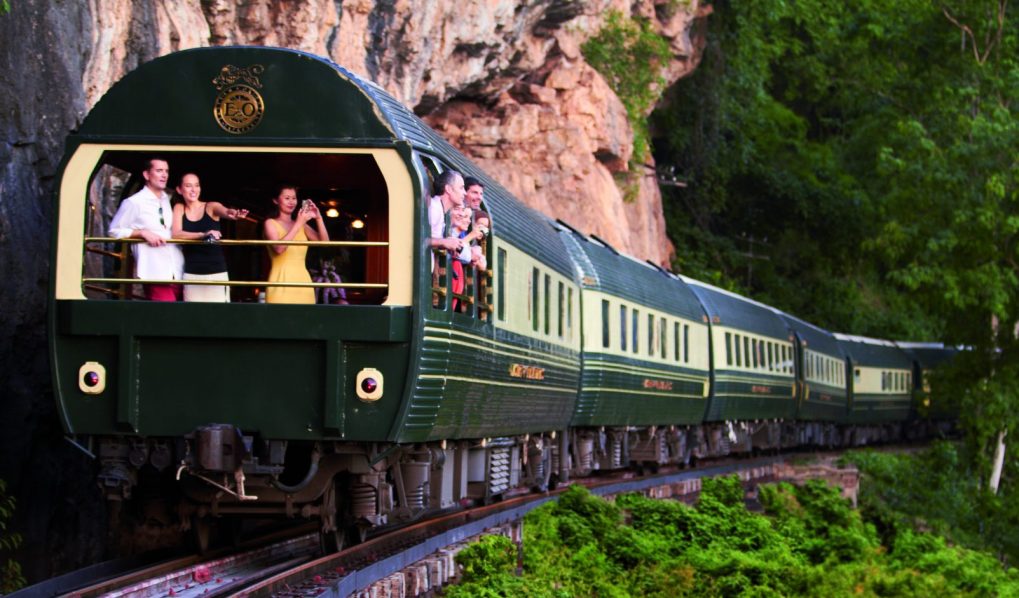
    Girl in red dress on the Eastern & Oriental Express rear open-air car

    The Eastern & Oriental Express' rear open-air lounge car is a favorite photo spot for passengers. IRT photo by Eleanor Hardy

  • the Eastern & Oriental Express, normally running between Bangkok and Singapore, but occasionally making week-long trips throughout Thailand and beyond (one of which — “Epic Thailand” — is next year’s Society group tour;
  • the Hiram Bingham, making the three-hour trip in style between Cusco and Machu Picchu in Peru;

N. America has just one appearance on the “World’s Top 25″ list, but it’s a stunner: the Royal Canadian Pacific, based in Calgary and operating on a very limited basis—just three trips in 2012.

Bianca Vos on Rovos Rail

Bianca Vos, daughter of Rovos Rail founder Rohan Vos, works full time for her dad. Here she is on the IRT Society's 'Owners' Choice' Cape Town-Dar es Salaam tour last July. IRT photo by Owen Hardy

Last but far from luxurious least is South Africa’s Pride of Africa, run by Rovos Rail, which offers probably the world’s most incredible luxury-rail experiences. Operating all over S. Africa as well as, occasionally, to Namibia, Botswana, Zambia, Zimbabwe and Tanzania, the train overcomes inhospitable climate, lack of infrastructure and a maze of red tape to offer an almost seamless product. Once you’ve ridden with Rovos Rail (which, with 25 IRT Society members, Eleanor and I did last July from Cape Town to Dar es Salaam) you won’t want to see Africa any other way.

The emphasis on luxury in no way denigrates the others on the “Top 25″ list. The Budapest-Istanbul Danube Express, Switzerland’s Glacier and Bernina Expresses and Norway’s tiny Flåm Railway all are not-to-miss European railroad experiences.

China’s Shangri-La Express can’t be called a luxury train. But it sure beats riding a regular Chinese train and likely will continue to do so until the much-vaunted Chinese Tangula Express luxury trains begin running (if ever).

Diners on Rocky Mountaineer

IRT Society travelers Gary and Joann Campbell dine aboard the Rocky Mountaineer Goldleaf dome. IRT photo courtesy of Gary Campbell

Over in the Western Hemisphere, Peru’s Andean Explorer offers an unforgettable all-day ride, along the top of the world, from Cusco to Lake Titicaca; farther north, Canada’s Rocky Mountaineer offers a great, all-daylight ride (our advise: splurge for a spot in the GoldLeaf dome).

Half a world away, finally, great railway experiences can be had in Australia, the only continent that can boast two trans-continental trains: the Sydney-Perth Indian Pacific and the Adelaide-Alice Springs-Darwin Ghan. Platinum Service, introduced several years ago, makes the going even better.

So there you have it: the World’s Top 25 Trains for 2012. Again, to download our publication now, click here.

What’s that you say? You have a differing opinion? Please tell us. What are your “Top 25?” Now’s the time to join the conversation!

Society Wins 4 Top Awards

21 Oct
Society of IRT 2011 Tour Book

Gold Award winner. Society President Eleanor Hardy appears on cover of the IRT Society's Best-Loved Railway Journeys 2011. Mrs. Hardy is dining aboard the Venice Simplon-Orient-Express. IRT photo by Owen Hardy

The Society of International Railway Travelers®, in business for 28 years selling deluxe and luxury rail travel world-wide, has garnered four top national marketing awards for 2011.

The Society won three Gold Magellan Awards and one Silver Magellan Award, a prestigious travel industry honor sponsored by Travel Weekly, a trade publication and travel media company. The Society of IRT is the only rail specialist to win a Magellan award.

“It’s great news, especially considering the travel industry giants we were up against,” including American Express Travel, Vacations.com and Expedia, said Eleanor Hardy, President. “I am proud that we have produced inspiring publications that encourage people to travel on beautiful trains.”

Gold Awards were announced for the Society’s website (www.irtsociety.com); Track 25, the Society’s blog (www.blog.irtsociety.com), and The IRT Society’s Best-Loved Railway Journeys 2011, a full-color, 60-page annual publication featuring luxury and deluxe rail tours world-wide. It features the World’s Top 25 Trains and the best journeys to take on them, and is full of first-hand reviews and reporting and photography from Society of IRT staff and members.

A full-page magazine ad promoting the Society’s World’s Top 25 Trains™ won a Silver award.

IRT Society web site

Gold Award Winner: Society of IRT website

Owen Hardy is the publisher of all IRT publications in print and on the web. Angela Walker, Vice President of Operations, is Associate Editor. Stephen Sebree, owner of Moonlight Graphic Works, is the graphic artist and designer for all print publications, ads and IRT logos. All live in Louisville, Kentucky in the United States. The rest of the Society of IRT team includes Mrs. Hardy, managing tour operations, and Margaret Langner, assisting in all areas of IRT operations, including setting up our blog.

Started in 1983 by Owen Hardy, a former Courier-Journal arts critic, the Society was one of the world’s first agencies specializing in international, high-end rail travel. The Society’s World’s Top 25 Trains™ list, begun in 2006, sets an international standard for luxury rail.

The Society’s list includes iconic names, such as the Venice Simplon-Orient-Express and the Golden Eagle Trans-Siberian Express, as well as newcomers, such as India’s Maharajas’ Express.

Owen and Eleanor Hardy on the Blue Train

Owen and Eleanor Hardy on the Blue Train. IRT Photo

“We pride ourselves in having direct experience with the rail journeys we sell,” said Mrs. Hardy, who has personally ridden 20 of the Society’s World’s Top 25 Trains.

In recent years, the Society’s marketing truly has gone global, with new customers from as far away as Australia, New Zealand, China, the Philippines, Brazil and the United Arab Emirates.

We thank you so much for your support — and your news and feedback about your train trips.  That’s what really makes this happen.

For more information on the Society, please call toll-free (800) 478-4881 in the U.S. and Canada; (502) 454-0277 elsewhere, or email tourdesk@irtsociety.com. To see the complete list of 2011 Magellan Award winners, go to www.travelweeklyawards.com

Spain’s Luxury Al-Andalus Resumes Operation in 2012

17 Oct
Al-AndalusSouthern Spain’s opulent, broad-gauge Al-Andalus is scheduled to return to the rails May, 2012, with its 1920s-era cars newly renovated. The train cancelled departures in May, 2005, following problems with its operator, Iberrail. It has been inactive since that time.

“We’re thrilled Al-Andalus is back on the rails,” said Eleanor Hardy, president of The Society of International Railway Travelers®. The Society is a world-wide booking agent for Al-Andalus, whose amenities include a bar, tea room and two dining cars, as well as all-en suite cabins.

The six-day, five-night tour will begin/end in Seville, with stops in Córdoba, Granada, Cádiz and Jerez. The train’s itinerary combines fine dining and wine with visits to iconic Spanish tourist sites, many of whom have won UNESCO World Heritage status.

Tour highlights include visits to the famed Alhambra, the Royal Andalusian School of Equestrian Art, and Doñana Natural Park, largest of its kind in Europe. Owned by RENFE, operator of Spain’s broad-gauge and high-speed services, Al-Andalus will be run by FEVE, the public authority responsible for narrow-
gauge services in N. Spain.
“Al Andalus couldn’t be in better hands,” said Hardy. “Since 1983, FEVE has run the popular luxury train El Transbantábrico with great success. This year it introduced the new luxury service El Transbantábrico Gran Lujo. They’re very experienced in the business of running high-end rail tours.”
Al-Andalus
Al-Andalus prices start at €2,500 (about $3,500 U.S.) per person, double, standard class; €2,950 (about $4,100 U.S.) per person, double, superior class. IRT will review the train soon after its seasons begins next spring.  We’re confident it will be a huge success because IRT guests who took this train before it ceased operation are still talking about it; others have asked about it for years. To book, please call (800) 478-4881 in the U.S. and Canada; elsewhere, please call (502) 454-0277. To see a detailed itinerary, please click here.
Will it be a World’s Top 25 Train? What do you think?

Last Frontier: The Silk Road

22 Sep

(Editor’s note: Author Chris Card Fuller’s story about her 2007 Silk Road trip originally appeared in The International Railway Traveler® magazine, republished here with permission. Please note that although the itinerary is essentially unchanged, the tour operator no longer offers Heritage Class accommodations on the Golden Eagle Trans-Siberian Express.)

The Shangri-La Express travels in late afternoon sunlight. GW Travel Photo

A gust of wind chases autumn leaves around the pavement. The flash of yellow and gold leaves and purple heather in the intense sunlight comes as a surprise, considering that we’re wedged in between three deserts. I’m just about to catch the perfect video clip of the Golden Eagle Trans-Siberian Express gliding into Dostyk, Kazakhstan.

We’re standing on the platform of Kazakhstan’s border town with China’s Xinjiang province. In 21 days, we will have covered almost 7,000 miles, from Beijing to Moscow, traversing some of the most inhospitable, lowest, hottest terrain on the planet. Until we actually catch some of the sand between our toes and view a dune from our perch on a camel’s back, the magnitude of our journey doesn’t begin to sink in.

Chinese waitress on the Shangri-La Express

Expert tea service - a warm welcome is part of this centuries-old art form. Photo © Chris Card Fuller

This is the famed Silk Route. We’re separated from the world by unforgiving deserts and mountain ranges–the Tian Shan, the Pamirs Karakorum and the Kopa Degh. And to get to places like Mary, Turkmenistan, by way of Samarkand and Bukara in Uzbekistan and Almaty in Kazakhstan, you must have the proper visas. Camels can walk across these borders easier than tourists. Traveling by private train is one of the few ways you can get there.

We greet 90 west-to-east passengers emerging from their shiny blue compartments of the Golden Eagle Trans-Siberian Express, assisted by smartly uniformed Russian railway car attendants. They’ve just finished the first half of their trek which began in Moscow with stops in Volgograd, Khiva, Samarkand, Bukara, Almaty and Tashkent, before switching trains with us to finish the second half of their voyage on ‘our’ train the Shangri-la Express. Ahead of them lies the Tarim Basin, the Gobi Desert, and the Mogao’s Buddhist caves, carved between 1,500 and 1,600 years ago. In Xian, 6,000 terracotta warriors await their arrival. They’ll finish up where we began – at the Peninsula Hotel in Beijing, China’s 21st century capital and home to the 2008 Summer Olympics.

Chris Fuller aboard the Trans-Siberian Express

The author's husband, Chris Fuller, relaxes in the dining car after a meal aboard the Trans-Siberian Express, one of two trains used on the Silk Road tour. Photo © Chris Card Fuller

East-bound passengers will be learning to use chopsticks just about the time that we’re getting comfy in a Kazakh yurt. In the flurry of video and picture-taking with Kazakstan’s neatly turned-out border guards, we gather up our plunder – silks from Xian and pashminas from Turpan – before boarding the Golden Eagle Express. The blue and gold compartments are a welcome sight: all three categories are comfortable: Heritage class with twin beds, Silver Class with a double bed, and additional overhead bunk, a private shower and toilet facilities, closet, and TV/Video/CD player. Gold Class offers a little more closet space and shower space than Silver Class plus easy access to the bar car and the Gold Dining Car. Generous serving of vodka, unlimited wine with meals served in crystal stemware, caviar and sturgeon for our welcome and farewell dinners, 24 hour coffee and tea service in our compartments – such luxurious details – can be distracting. We’re traversing the harshest of deserts and mountain passes in the protective cocoon of our air-conditioned private train.

Village luncheon hosts near Mary, Turkmenistan flank the author. Photo © Chris Card Fuller

Village luncheon hosts near Mary, Turkmenistan flank the author. Photo © Chris Card Fuller

If you think train travel over several thousand miles of desert might be boring, it isn’t…

Oasis towns like Turpan in Xinjiang, China are lush and brimming with vineyards. Poplar trees line the newly constructed asphalt Silk Road highway. In Samarkand, nothing is quite as exotic as the haute-couture-clad Uzbeki models tearing up the catwalk during our private fashion show in a merchant’s former private palace.

Almaty, Kazakhstan’s modern capital city, is the antithesis of rustic. It may be where the apple originated, but you’ll find more stretch limos here than apple orchards. We’re entertained in a carpeted yurt restaurant, but the performers sing arias just as proficiently as traditional folksongs.

A worker delivers a load of supplies for the train during one of the many stops between Lanzhou and Golmud. Photo by Angela Walker, IRT

A worker delivers a load of supplies for the Shangri-La Express during one of the many stops between Lanzhou and Golmud. Photo by Angela Walker, © IRT

Food in Central Asia is also a pleasant surprise. For local lunches and dinners, we’re served hearty soups, spiced meats and plentiful vegetables with rice pilaf and fresh pita bread. Most meals begin with a plate of pickled raw vegetables such as cucumbers and beets, local cheeses and olives. Sweet melons and dried fruits are specialties of these oases towns.

“We are the lowest, the hottest, and the sweetest place on earth,” is how Zeba, a Turpan resident guide, describes her oasis home in the Taklimakan desert. The desert offers up a few, but not all, of its secrets.

At the Urumchi Provincial museum in China’s Xinjiang province, we meet the ‘Loulan Beauty’. This blond-haired Indo-European petrified corpse was officially dated at 3,700-years-old, yet some archeologists believe she may be even older.

Crescent Spring

Surrounded by sand dunes, Crescent Spring appears like a mirage. Photo © Chris Card Fuller

The 2,300-year-old ruins of Jiaohe city near Turpan used to be a Han-era garrison town built to fend off northern marauders. This complex of carefully laid-out city streets has been described as “the largest, oldest and best-preserved earthen city in the world.”

I’m no history expert. My Tang and Han dynasty dates usually get twisted up in a knot, but of one thing, I’m dead certain: As soon as this trip ends, I’ll want to hop right back on the train and see it all again.

(When not traveling, Chris Card Fuller divides her time between Paris, France and Florida.)

For more information on the Silk Road tour, please click here.

Rovos: Club-Like Comfort from Cape Town to Dar es Salaam

1 Sep

Society CEO Owen Hardy and member David Cowley, spruced up for the final dinner before arrival in Dar es Salaam, share a drink at the outdoor platform in the rear lounge car. IRT Photo by Eleanor Hardy

(Continued from Part 1)

While the Eastern & Oriental Express or the Venice Simplon-Orient-Express probably win the top awards for utter beauty, Rovos Rail’s Pride of Africa is more like a comfortable London club.

That’s where we spent some of the best moments of our recent Cape Town – Dar es Salaam “Owners’ Choice” group tour last month. (To read my first installment, click here.)

Interiors, constructed in Rovos’ Capital Park headquarters in Pretoria, are outfitted in dark, varnished Rhodesian teak, with polished brass, thick carpeting and, in the diners, gleaming silver, crystal and cutlery.

King size bed in Rovos Rail Deluxe Suite. IRT photo by Eleanor Hardy

Our deluxe suite was spacious and tastefully appointed, with all the standard amenities – shampoo, conditioner, fine soap, shoe mitt, etc. — one would expect of a five-star hotel.  We loved it: it was the biggest compartment we have experienced. And if we were delighted, our IRT guests in the Royal Suite, with its two armchairs and full-sized Victorian porcelain bathtub, were thrilled with their half-a-train-car accommodation.

Our first day on the train commenced as so many would thereafter: with leisure spent in the privacy of our cabin, followed by a visit down to the rear lounge car to enjoy its over-sized outdoor section. Soon afterwards, we heard the mellifluous sound of chimes,  rung by a Rovos Rail staff member walking the length of the train, signaling that lunch was being served.

Meals on Rovos Rail are grand affairs. Lunch and dinner typically include four courses.

Cheese course is served at lunch and dinner. IRT photo by Eleanor Hardy

Following a starter is the main course, which could be fish, lamb, beef or, more exotically: springbok (tastes like steak) or ostrich (also tastes like steak). Imaginative vegetarian options also are available. Next comes a cheese course, followed by dessert and coffee or tea.

Mulderbosch Chenin Blanc

Mulderbosch Chenin Blanc

A word of warning about meals: each course is paired with an excellent South African wine. On our trip, wine stewards Gareth van Wyk and Michael van Rooyen enthusiastically described their wines’ provenance and taste characteristics.

But while sometimes one wine will work for two courses, many times each course will be paired with a different wine, including, at dessert, a liqueur such as Kahlua or Frangelico, or one of the many fine South African dessert wines.

If you’re like me, you’ll want to try them all, but the cumulative effect can be debilitating. And don’t forget: there are many all-train days, when your natural tendency will be to move following the meal to one of the two lounges, where more (“free”) wine and spirits are flowing. So pace yourself.

Fidgety types might wonder what one does all day on a train. On the Pride of Africa, the list of possibilities is long – and each passenger seems to develop his own routine and favorite perch.

In our case, the most serious photographers hung out at the rear. In fact, they rarely left their privileged positions.

Waving children

Children love trains everywhere - including Africa. IRT photo by Eleanor Hardy

(So don’t be afraid to speak up and request equal time. There’s nothing better than viewing an African sunset from that vantage point. And whole villages seem to empty their children beside the tracks to wave to the train people rattling by. Waving back, one can’t help but feel a bit like visiting royalty.)

Other people liked the indoor section of the lounge, with its sumptuous cakes and finger sandwiches during afternoon tea, or the ready drinks from the bar, available anytime.

Still others liked the front lounge and the services of Nicholas Schofield, the train historian, who delivered five lectures, each about an hour, on African history, politics and culture in his singular, breathless style, which makes him impossible not to enjoy.

Unlike many on-board academics, who seem to hide in their cabins between lectures, the ever-chipper Mr. Schofield makes himself available to all. Arrive early to get the best seats; double-check timings daily because they are subject to change.

Looking out a Rovos Rail window.

IRT Society President Eleanor Hardy enjoys her favorite pasttime: looking out her compartment window. IRT photo by Owen Hardy

Another option is to visit hairdresser Craig Geater’s salon – included in your fare. After almost 3 weeks in Africa, I definitely was ready for a haircut and beard trim, which Craig expertly provided in his tiny quarters. But be reasonable in your expectations. You’re in a moving, sometimes jolting train, after all, so don’t ask for a shave with a straight-edge razor. No one wants an impromptu performance of Sweeney Todd. But it was a blast to be rolling along, Tanzania’s gorges and mountains rolling by, while Craig trimmed our hair.

Finally, if you’re the quieter type, you might prefer simply sitting in your private room, looking out of one of the multiple windows, as did IRT travelers Sam and Betty Nuckolls. Sipping their Jack Daniels, they happily watched Africa unfurl as if they had a front-row seat at an old-fashioned Cinerama movie theatre.

All in all, it’s a great way to travel.

(Watch for my final installment: Rovos Rail Cape Town – Dar es Salaam off-train tours)

Follow

Get every new post delivered to your Inbox.

Join 215 other followers

%d bloggers like this: